MTEL Elementary Math Practice Test and Study Guide
This study guide for the Massachusetts Tests for Educator Licensure (MTEL) Elementary Math Test will provide basic information on what the test is and who must take it, as well as what the test covers, required scores to pass, and how to prepare for the exam. Should the worst happen, this guide also addresses what a prospective teacher should do if they fail.
1. Number Systems and Operations (30%) 2. Algebraic Thinking and Relations (20%) 3. Geometry (15%) 4. Measurement, Data, and Probability (15%) 5. Integration of Knowledge and Understanding - Skills, Models, and Situations Related to Mathematical Standards (10%) 6. Integration of Knowledge and Understanding - Analysis of Mathematical Problem Solving (10%)
The MTEL Elementary Math test can fulfill the math subtest requirement for elementary teachers and math teachers up to sixth grade, as well as teachers of students with moderate disabilities (up to middle level) or severe disabilities, and teachers of the hearing- or visually-impaired. All of those teachers must pass a math subtest for certification, making preparation for this test with tools like MTEL Elementary Math (53) practice tests and this Elementary Math MTEL study guide vital for teachers starting their career. This test forbids the use of calculators; as such, applicants must ensure they know all of the fundamentals of math as covered in this test.
TeacherCertification.com
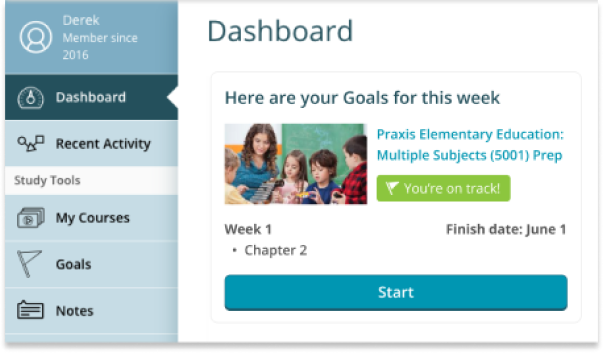
Get a personalized test prep course for the MTEL Mathematics (Elementary).
Take an assessment and focus on the areas that need the most practice.
The Content Found on the MTEL Elementary Math Test
The MTEL Elementary Math test is a computer-based test with 100 multiple-choice questions and two open-response questions. The multiple-choice questions are divided into three subjects: Number Sense, Operations, and Data Analysis; Patterns, Relations, and Algebra; and Geometry and Measurement. The open-response questions may be about any of these subjects. The first subarea, Number Sense, Operations, and Data Analysis, is the largest at roughly thirty percent of the test weight. This segment covers number theory in general, integers, fractions, decimals and percents, statistics and analysis, and probability. The section on Patterns, Relations, and Algebra covers patterns and functions presented in various forms, simplifying and solving algebraic equations, the properties of linear functions, ratios and proportions, and quadratic equations. Last, Geometry and Measurement covers units of measurement and conversion of units, principles of Euclidean geometry, the application of Euclidean geometry to analyze properties of shapes, and coordinate and transformational geometry. The open-response questions may be about any covered subject; as such, examinees must ensure they have a thorough understanding of all subject matter on the test. The open-response questions make up a total of 20% of the test score.
This is one of the more difficult tests offered by MTEL, with pass rates ranging from 42 to 46 percent among first-time takers. As such, those planning to take the test should consider MTEL 53 practice tests in preparation, for a good representation of what to expect on the real test.
Concise, engaging video lessons
Master concepts quickly with clips from expert instructors. You get both video lessons and test transcripts.
Save time by quickly reviewing video transcripts for essential lesson information.
Studying for the MTEL Elementary Math test is essential for success, but there is more to studying than sitting and reading.
A schedule should be made and stuck to, with time divided appropriately for the test's subject ratios; in the case of MTEL 53, Number Sense, Operations, and Data Analysis is slightly larger than the other two segments, at 30% to their 25% each. Obeying the schedule is important; we are limited in our capacity for long-term concentration. If an examinee spends too long studying, much of the time will be wasted as a result. The best way to avoid this is to spread studying across multiple days, which will also allow a test-taker the opportunity to reinforce their understanding by covering the same subject multiple times.
Time spent studying should also include time spent not studying. As said above, it's difficult to focus on one task for hours on end. Occasional breaks should be taken for snacks, drinks, and just to process information without pressure.
Study environment is important. An ideal study environment has minimal distractions, though what each individual finds most conducive to focus will vary. Successful test-takers identify both distractions and things that aid in focusing; someone whose mind wanders in silence may find music helps to stay on task, for example. Someone distracted by people moving around near them may find a quiet coffee shop to still provide too much distraction from other customers.
Distractions aren't always external, they can be in our own minds and bodies as well. Candidates that can't shake fears about sick family, for example, may be better served trying again another day. This shouldn't be taken as leave to procrastinate, however; anxious prospects should ask themselves if they are actually distracted or if they are simply trying to delay. Food and drink are also important; thirst and hunger are very effective distractions.
Mistakes should be treated as tools for learning, not failures. For example, if an aspiring teacher knows he has difficulty with fractions, this should tell him to focus his efforts on them.
To that end, MTEL Elementary Math practice tests are an invaluable resource for effective study. They provide a way for examinees to gauge their knowledge as they go, both to reinforce understanding of what they do know and to highlight their weaknesses before the real test, to guide further study. These will be covered more in the next section.
Practice Tests Available for the MTEL Elementary Math Test
As addressed previously, practice tests can be an exceptional aid in studying for the MTEL Elementary Math exam, and should be taken several times throughout study. Early in the study plan, these tests will help test-takers identify where they need improvement, while toward the end, they can alleviate anxiety by showing examinees how much they've learned. MTEL offers a free, full-length practice test on their website. Their practice test also includes open-response questions, along with sample strong and weak answers to ensure test-takers know what is expected of them.
While the MTEL practice tests are extremely useful, care must be taken not to only study the specific questions on those tests; while the general subject matter is the same, the specific questions will vary. In particular, the two open-response questions can be about any of the three subject areas on the exam. One way examinees can avoid this pitfall is taking multiple different practice tests throughout their studies.
What to Expect When Taking the MTEL Elementary Math Test
The MTEL Elementary Math test is a computer-based test with 100 multiple-choice and two open-response questions, with four hours scheduled for the test. MTEL passing score is scaled to a range of 100 to 300, with 240 being required to pass. The registration fee is $139, payable via Visa or MasterCard credit or debit card; examinees without a qualifying card may contact Evaluation Systems to pay via check. This MTEL test cost is another reason to take Elementary Math MTEL practice tests, so examinees don't have to pay twice. Tests are available by appointment only, year-round except for Sundays and some holidays, with locations available in Massachusetts and throughout the United States.
As mentioned earlier, calculators are forbidden during the test; as such, applicants should use this Elementary Math MTEL study guide to ensure their preparation is as thorough as possible. The open-response questions may need to be written out on paper and scanned. MTEL test results are reported approximately once per month, posted online on a set schedule at 10:00 p.m.
Those taking the test may not leave the MTEL testing sites during the session. Most electronics are forbidden, along with any unauthorized equipment and any food and drink. Owing to that last one, those taking the test should ensure they are hydrated and well fed prior to the test. Test-takers must also bring government-issued identification with both photograph and picture; this may be a driver's license, passport, state photo ID, military ID, or Alien Registration Card.
Examinees with disabilities or nursing mothers that require alternative arrangements will need to request those arrangements in advance.
What to Do if You Fail the MTEL Elementary Math Test
Should an applicant fail the MTEL Elementary Math exam, their registration fee will not be refunded. They will be able to sign up for MTEL and retake the exam 45 days after taking the test. Their score report will provide some details on performance; each subarea will have a broad description of whether they correctly answered "most or all items", "many of the items", "some of the items", or "few or no items". Similarly, the open-response portion will indicate if the answer was "thorough", "adequate", "limited", or "weak". While this doesn't provide a specific pass or fail per-section, this will still provide useful information to guide preparation for retaking the exam.
This is one of MTEL's harder tests, so examinees should not be disheartened if they fail their first attempt; pass rates for those who aren't taking it for the first time are consistently approximately three percent higher, and using a score report to guide study for a second attempt should help an aspiring teacher to be part of that three percent. For comparison, the Middle School Mathematics and Science test has recently shown a reduced success rate on non-first-time examinees. While studying to prepare for a retake, examinees should regularly take MTEL Elementary Math practice tests to identify and correct their weaknesses.
Frequently Asked Questions
How hard is the math MTEL?
The MTEL Elementary Mathematics test is one of MTEL's more challenging offerings, with pass rates in the 40-50% range. To compare, Mathematics (09) has pass rates in the 75-80% range, the highest of the math-related tests. The lowest pass rate for first-time takers in 2019-2020 was Earth Science, at only 30.8%.
How many questions are on the math MTEL?
The Elementary Mathematics MTEL test has 100 multiple-choice questions and two open-response items. The multiple-choice test has three subareas, with Number Sense, Operations, and Data Analysis having slightly more weight on the test than either Patterns, Relations, and Algebra or Geometry and Measurement.
How long is the MTEL math test?
The MTEL Elementary Mathematics test gives examinees four hours of scheduled test time after a fifteen minute orientation on computer-based testing.
How do you pass the general curriculum MTEL?
The MTEL General Curriculum test has a mathematics subtest and a multi-subject subtest. The Elementary Mathematics test can fill the mathematics subtest requirement.
Over 100,000 Video Lessons & Practice Questions - All In One Place.