MTEL General Curriculum Math Subtest Practice Test and Study Guide
This study guide is focused on the math subtest of the Massachusetts Tests for Educator Licensure (MTEL) General Curriculum exam. It will cover the different parts of the subtest, their approximate weighting and distribution within the test, and how the test is administered. This guide will then address effective study techniques, a key topic that reveals there is more to studying than simply reading a book. The guide concludes with preparation advice for the day of the MTEL exam, including what forms of identification are needed at MTEL testing centers and how to approach the test.
The MTEL General Curriculum Math Subtest is designed to evaluate a prospective teacher's understanding of and ability to teach the foundations of math. This subtest, or an equivalent mathematics test, is required for elementary-level teachers, teachers of visually- or hearing-impaired students and students with severe disabilities of all grade levels, and teachers of students with moderate disabilities up to grade 8. It is also one of the exam options for teachers of students with moderate disabilities from grades 5 to 12. As it is required for initial certification in Massachusetts, the math MTEL is a very important test for prospective educators. It is administered via computer, and since calculators are not permitted, candidates must be confident in their understanding of foundational math. More on the structure of the test follows in the next section.
TeacherCertification.com
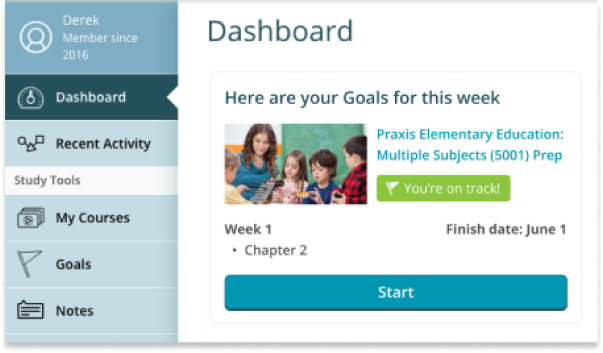
Get a personalized test prep course for the MTEL General Curriculum - Math Subtest.
Take an assessment and focus on the areas that need the most practice.
The math subtest of the MTEL General Curriculum test is a computer-based test (CBT) with 45 multiple-choice questions and one open-response item. It is divided into five subareas: Numbers and Operations, Functions and Algebra, Geometry and Measurement, Statistics and Probability, and an open-response item that may relate to any of the preceding subject areas.
Numbers and Operations is the largest section of the test, with 19-21 questions making up approximately 41% of the test score. Functions and Algebra is a significantly smaller segment, with 10-12 questions divided between three objectives, making up 22% of the score. The third subarea is Geometry and Measurement, slightly smaller than the previous at 8-10 questions that make up 18% of the test score. The fourth subarea is Statistics and Probability. Of the multiple-choice subjects, it's the smallest at only 4-6 questions, and at 9% it makes up the smallest portion of the test score.
The MTEL Math subtest open-response item requires examinees to demonstrate mathematical reasoning to offer multiple ways to solve a math problem, to evaluate their ability to communicate concepts of mathematics to their students.
Pass rates for this subtest are lower than the multi-subject portion of General Curriculum and roughly in the middle band of the MTEL Math tests; in the 2019-2020 school year, first-time applicants had an MTEL passing rate of 53%, compared to 62% for Middle School Mathematics and 42% for Elementary Mathematics. As such, it can be considered an MTEL test of moderate difficulty.
TeacherCertification.com
Watch concise and engaging video lessons that help with MTEL General Curriculum - Math Subtest prep.
Master concepts quickly with clips from expert instructors
You get both video lessons and test transcripts
Save time by quickly reviewing video transcripts for essential lesson information
With how important the MTEL General Curriculum Math Subtest is to start a career in teaching, proper study techniques are essential. There is more to studying than simply cramming the day before the exam; in fact, this approach is widely considered wasteful and ineffective. Instead, candidates should follow a study schedule over the span of multiple days. A test-taker's initial schedule for their MTEL Math prep should be weighted in a similar manner to the test itself; for example, studying numbers and operations should take the largest portion of study time because it has the most weight on the exam.
Study sessions should not be excessively long; a person's capacity to concentrate on one thing has its limits. It is recommended to break up sessions with brief breaks approximately every hour to rest, relax, or possibly get a snack. This helps to avoid burnout and mental exhaustion. Each subject should be studied multiple times throughout preparation for the MTEL. This reinforces knowledge of the material in the mind of an examinee.
One's study environment is important. Distractions, in whatever form they take, should be minimized. Those who have trouble putting their phones down, for example, should put their phones in a different room. Some find that music helps them focus, while others find it another distraction. Those studying for this exam must determine their own ideal environment.
Distractions can also come from within. Hydration is important, and distractions from one's own mind can have severe impacts on the quality of study. If someone cannot get their mind off an argument earlier in the day, for example, they may find it more effective to simply postpone that day's study session.
Some students find that they learn better when there is an instructor or pre-structured syllabus to guide them as they prepare. In this instance, taking an MTEL Math prep course may be particularly beneficial. There are a number of different MTEL prep courses for the MTEL Math available to prospective educators looking to broaden their preparation strategies.
Practice tests are another incredibly useful tool in MTEL Math test prep. Optimally, MTEL practice tests should be taken several times during the course of studying for the MTEL Math Subtest. Test-takers should remember that errors are not a catastrophe - they simply serve as a guide for further study.
MTEL General Curriculum Math Subtest Practice Test
MTEL Math practice tests can be found through various venues online. These practice tests are a useful resource for several reasons, including the fact that they reinforce which subjects are covered and help to highlight a test-taker's strengths and weaknesses in the subject. As addressed previously, errors on the practice test are just as useful as correct answers. Knowing where there are knowledge gaps allows test-takers to specifically focus their studies in order to fill those gaps. Identifying the skills that test-takers have already mastered is also beneficial because it keeps them from excessively studying.
However, those studying for the MTEL Math Subtest should take care not to become too focused on memorizing sample questions. Any MTEL practice test is not a perfect representation of the test that will be taken for certification, and as such test-takers must not tailor their studies to match the exact contents of the practice test and nothing more. Similarly, though a test-taker may have identified things they understand, they should not completely stop studying that topic; the reinforcement of what information is already known is another useful aspect of the MTEL Mathematics practice test.
TeacherCertification.com
Find self-paced MTEL General Curriculum - Math Subtest prep courses.
Find a study plan that can get you ready for your certification exam, whether you have six months or six days.
MTEL General Curriculum Math Subtest Testing Details
Passing the MTEL General Curriculum Math Subtest requires a scaled score of 240, on a scale of 100 to 300. The MTEL registration for one subtest costs $94, while registering for both the Mathematics Subtest and the Multi-Subject Subtest together costs $139. This fee is payable online with a Visa or MasterCard debit or credit card; applicants without a qualifying card must contact Evaluation Systems to arrange payment by check. The tests are scheduled for a four-hour block whether taken separately or together, and if an examinee chooses to register for both, they can be taken on different days. MTEL test dates are made online, and may be scheduled year-round, with the exception of Sundays and some holidays. Test locations are available both in Massachusetts and elsewhere in the United States.
MTEL test results are given approximately twice per month according to a fixed schedule and will be posted online at 10:00 p.m. Calculators are prohibited, and as such, candidates must be sure of their understanding of math.
Tips for Your MTEL General Curriculum Math Subtest Testing Day
To ensure their appointment to take the MTEL General Curriculum Math Subtest proceeds as smoothly as possible, candidates should prepare in advance. Late arrivals may not be admitted to the test, and in that event will be counted as absentee; therefore, test-takers should plan to arrive 15-20 minutes early. Food and drink is not permitted at the MTEL testing sites, so examinees should ensure they have eaten before the test. Breaks may be taken during the MTEL exam, but unscheduled breaks do not stop the test clock and candidates may not leave the building.
Identification is required to access the testing site. Ideally, this will take the form of government-issued ID with a visible signature and photograph, such as a driver's license, state ID, passport, or permanent resident visa. If a candidate's government-issued ID lacks either the signature or photograph, a valid ID with a matching name and recent photograph or signature must accompany it.
Frequently Asked Questions
What is on the MTEL?
The MTEL General Curriculum test consists of a multi-subject subtest and a mathematics subtest. The mathematics portion covers numbers and operations, functions and algebra, geometry and measurement, statistics and probability, and the integration of knowledge from multiple subject areas.
How hard is the general curriculum MTEL?
The combined General Curriculum exam is moderately difficult, with a pass rate of 47% for first-time examinees in the 2019-2020 school year. Of its subtests, the mathematics test is harder, with a first-time pass rate of 53% compared to the multi-subject's 68%.
How long is the general curriculum math MTEL?
The mathematics subtest of the MTEL General Curriculum test consists of 45 multiple-choice questions and one open-response item. Test appointments are for a four-hour block, whether for one subtest or for the full General Curriculum exam.
Can you use a calculator on the math MTEL?
Calculators are not permitted on-site for any MTEL test, including the mathematics subtest of the MTEL General Curriculum exam. This also includes a ban on calculator watches and phones in general.
Over 100,000 Video Lessons & Practice Questions - All In One Place.