The Top 5 Things Teachers Say Would Alleviate Burnout
Written by: Leesa Davis
 |
In a January 2022 National Education Association survey of its members, 90% of educators called burnout a significant problem. Teacher burnout has existed for years, but the COVID-19 pandemic intensified it for many. More than half of NEA survey respondents said they're likelier to leave the field sooner than anticipated. According to Bureau of Labor Statistics data, the June quit rate for state and local government education employees was lower than the quit rate for all occupations. But at above 1% for most of 2022, the quit rate has been generally higher than in pre-pandemic years.
Teachers need help-perhaps more now than ever in recent memory.
Once the pandemic hit, anxiety levels rose for many educators who had to quickly adjust to an unprecedented teaching model, shifting from a traditional classroom to a virtual learning experience. Many teachers quit due to fear of exposure to COVID-19, and some simply pivoted to other professions. There were also a high number of absences among teachers. As a result, staffing shortages ensued, which caused existing teachers to work longer hours with higher demands, which spiraled into a heavier workload. Many educators have also confessed to feeling undervalued socially and by administrative staff.
While most school staff, parents, and students have returned to in-person learning schedules, the pandemic's impact on the American education system lingers, with students months behind on learning. Noticeable test score gaps also continue to affect disadvantaged students disproportionately. As students fall behind academically, educators' mental health is simultaneously taking a hit. A 2022 Rand Corp. study found that "teachers and principals reported worse well-being than other working adults."
Teachercertification.com compiled the following actions that educators said would alleviate teacher burnout based on that National Education Association survey.
 |
#5. Fewer Paperwork Requirements
- About 90% of teachers support this measure
Reducing paperwork for teachers could allow more time to focus on the needs of their students.
Teachers are often overwhelmed by paperwork, whether it's regarding disciplinary issues or covering for absent coworkers. The teaching profession is a heavily legislated one, for special education teachers in particular. The Individuals with Disabilities Education Act requires students with special needs to have detailed documentation of their educational curriculum.
 |
#4. Hire More Support Staff
- About 92% of teachers support this measure
The NEA survey found that 55% of school teachers said they are more likely to leave education or retire earlier than planned due to, among other reasons, "an unprecedented level of strain made worse by recent dire staff shortages." (That's almost double the figure NEA found in a July 2020 survey.)
Teachers said they would benefit tremendously from having more support from colleagues. That includes access to mentorship opportunities that can help new teachers grow and develop. A 2011 study by Ingersoll & Strong found mentorship from veteran educators greatly benefited new teachers and increased teacher retention rates.
 |
Use TeacherCertification.com's practice tests and study tools to pass your Praxis exam and become a teacher in a snap.
#3. Provide Additional Mental Health/Behavioral Support for Students
- About 94% of teachers support this measure
Teachers believe addressing student behavioral issues can help in combating staff burnout. The COVID-19 pandemic has contributed to increased behavioral problems as students find ways to cope after the pandemic disrupted their educational and social lives. In addition to teacher fatigue, behavioral issues displayed by some students have made learning environments more challenging.
While resources can guide teachers in handling mental health and behavioral issues, on-site support from counselors and social workers provides crucial aid to students and reduces the burden on teachers.
 |
#2. Hire More Teachers
- About 93% of teachers support this measure
School districts nationwide have been battling staffing shortages in recent years--shortages that the COVID-19 pandemic exacerbated. According to a June 2022 Institute of Education Sciences finding, 62% of public schools are concerned about filling vacant staffing roles. Among all subject areas reporting present vacancies, special education and elementary school posts are in dire need, with 47% and 45% unfilled nationwide, respectively.
The shortages are so dire that some districts across rural Texas have shifted to a four-day school week as they struggle with retention issues and the ability to hire new teachers. There's been a growing popularity of rural districts adopting a four-day school week to avoid staffing burnout and to remain competitive in the hiring market. Unfortunately, there hasn't been conclusive data on how this affects learning outcomes.
To attract more teachers, states such as California have allowed prospective educators to bypass basic skills if they've taken eligible college courses. California has also allowed teaching candidates more time to complete required tests to obtain teaching credentials.
 |
Interested in becoming a teacher? Use TeacherCertification.com's CBEST, FTCE, and TExES resources to prepare to ace your certification exams.
#1. Raise Educator Salaries
- About 96% of teachers support this measure
In most industries, wages are not keeping up with inflation. That includes teachers' salaries. In 2022, the NEA released an updated report on educators' salaries showing the average annual salary at $66,432 for the 2021-22 school year, which, while up $10,000 since 2021, nonetheless represents a $2,150 reduction in earnings when adjusted for inflation.
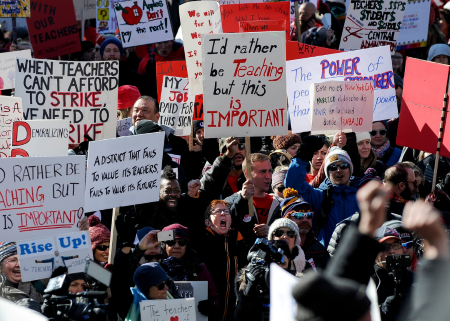
In March 2018, West Virginia teachers went on a nine-school-day strike, which caused closures in K-12 classrooms across the state's 55 counties. The teacher walkout wasn't just about compensation; teachers wanted to raise awareness about their daily challenges in helping students achieve positive educational outcomes. The strike ended when the state's governor increased teachers' earnings by 5%.
Expert Answers to Common Questions about the top 5 things teachers say would alleviate burnout
- How can student teachers get the most value of their teaching experiences in terms of determining which age groups, subjects, and types of school would be a fit for them?
- How do you help your students best prepare to pass their teacher certification exams?
- What is one piece of advice you wish you had when you were working to become a teacher?
- Which classroom management strategies may be the most helpful for prospective and new teachers to learn more about?
You can read their biographies and answers below:
-

Kerri D. Mahlum, Ed.D.
Early Childhood Education Instructor
Dr. Kerri Mahlum has been a member of the of the Education Department at Casper College in Casper, Wyoming since 2001. Kerri received her A.A. from Casper College, B.A from Union College in Lincoln, NE., and Ed.D. from the University of Wyoming. Kerri taught Kindergarten, 1st grade, and 2nd grade before moving to Casper College. She has taught at Casper College for 21 years. During her time in this position she has been able to advance the Early Childhood degree as one of the first in the state of Wyoming to be offered online. In 2016, the Casper College Early Childhood program also became the first in the state to receive NAEYC Higher Education Accreditation. Kerri loves children, teaching, spending time with her family, and her annual trips to Disneyworld!
-
How can student teachers get the most value of their teaching experiences in terms of determining which age groups, subjects, and types of school would be a fit for them?
I would recommend entering each practicum experience with an open mind and the goal of gleaning as much information as possible. Even if you are placed in a school that is not your ideal teaching scenario, you can find nuggets of helpful strategies. Or, at the very least you can learn what you do not want to replicate when you have a classroom of your own.
-
How do you help your students best prepare to pass their teacher certification exams?
I work on mindfulness. Most students are not concerned that they do not have the information in their minds. Rather, they are fearful of the testing environment itself. Many have clutched onto the mindset that they have test anxiety and that it is insurmountable. I work to help them center their thinking. I work to provide multiple opportunities to practice taking mock exams, so that they do not go into their tests with a fear of the unknown.
-
What is one piece of advice you wish you had when you were working to become a teacher?
I wish I had been given strategies to help create a work/life balance. As a young teacher, I felt an enormous weight on my shoulders to prove that I "knew what I was doing". As the newest member of our teaching team, I felt the way to prove my worth was to be the first to arrive, the last to leave, and to be at the school every weekend preparing for the next week's teaching. After a few years, this laser focus on work, took a toll and I had to step back and reevaluate. I learned the strategy of work smarter, not harder.
-
Which classroom management strategies may be the most helpful for prospective and new teachers to learn more about?
Proactive guidance is a key element in successful teaching. Young teachers need to have strategies to first develop relationships with students, and let students know appropriate limits, with gentle guidance. Students simply do not learn well when they are in a state of heightened emotions. When young teachers set clear limits, and provide appropriate positive affirmations and reinforcement, a caring classroom environment results. In this type of setting, children are eager and ready to learn.
-
All Teacher Certification Exams
- CBEST California Basic Educational Skills Test View Practice Tests
- FTCE Florida Teacher Certification Examinations View Practice Tests
- GACE Georgia Assessments for the Certification of Educators View Practice Tests
- ILTS Illinois Licensure Testing System View Practice Tests
- MTEL Massachusetts Tests for Educator Licensure View Practice Tests
- NYSTCE New York State Teacher Certification Examinations View Practice Tests
- Praxis Praxis View Practice Tests
- TExES Texas Examinations of Educator Standards View Practice Tests