The California Basic Educational Skills Test in Math (CBEST Math) is a required test for educators who wish to gain their first licensure to teach in public schools in California, Oregon, and Nevada. It forms one-third of the CBEST examination and requires its own registration fee. The CBEST is intended to assess subject matter knowledge rather than teaching ability, with the CBEST Math solely testing your mathematics content knowledge. The CBEST Math is divided into three skill groups: Numerical and Graphical Relationships; Computation and Problem Solving; and Estimation, Measurement, and Statistical Principles. The CBEST Math doesn't replace any other subject-specific test for teaching; it simply tests your general content knowledge before gaining licensure.
The CBEST Math exam is an appointment-only exam of 50 questions across the three skill sets detailed above. You will take the test at either an approved testing facility on a computer or paper or from a private computer under strict proctoring controls. Of the three skill sets, 30% of the questions are from estimation, measurement, and statistical principles; 35% are from computation and problem-solving; and 35% are from numerical and graphical relationships. These percentages are, however, an approximation. You will be given 2 hours to complete the entire test, with an additional 15 minutes to review a tutorial a nd nondisclosure agreement. You are not permitted to use a calculator in the examination room. CBEST test locations will provide you with only a pen and a booklet of paper for taking notes as you work. All other materials are forbidden in the testing room.
Numerical and Graphic Relationships
This section deals with basic relationships between numbers and data, such as computing percentages from one year's data to the next year. You will likely be asked to understand the relationship between fractions, identify the position of a fraction within a set of fractions, or determine if one is larger or smaller than another. Expect to use greater than/less than or equal to symbols, as well as demonstrate equivalence between fractions with different denominators, formulas, and percentages. The test will also require understanding of how to round numbers while solving a mathematical question.
You typically must know how to use basic Boolean logic by using connectors such as an/or/if/then and appropriate quantifier terms such as some/all/none. You may be presented with tabulated data and have to calculate the subtotal or a missing value. This may be a spreadsheet or other visualized data such as a bar, line or circle graph, and you may be required to solve a problem from the presented information.
Computation and Problem Solving
This section focuses on number operations, including algebra, and solving problems after being given limited information. It typically involves being required to add, subtract, multiply and divide whole numbers, as well as adding and subtracting negative numbers. You will likely be asked to perform a number of basic mathematical operations, including addition, subtraction, multiplication and division, using fractions, decimals and percentages.
This section involves basic algebraic problems such as solving for an unknown variable. You will likely be asked to study a problem and determine if it can be solved from the available facts. The test will likely ask you to perform operations to solve practical problems such as multiplying a quantity by a price to determine the total cost of an invoice, or by summing the items in a list. It typically also asks you to consider different mathematical ways of solving a given problem, relying on your ability to look at a problem using multiple methods.
Estimation, Measurement, and Statistical Principles
This section of the CBEST Math exam has two subsections: Estimation and Measurement, then Statistical Principles. The Estimation and Measurement section requires you to understand standard units of U.S. measurement for weight, temperature, length, and capacity. You should know how to measure length and perimeter, as well as estimate the results of an equation before computation when the problems involve addition, subtraction, multiplication, or division. Expect to find questions about estimation of time for planning and completing work objectives.
The Statistical Principles section involves understanding the operations, principles, and meaning of statistical data. Expect to carry out simple operations on test score statistics such as averages, percentiles, proportions, and ratios. Typically, the test has questions about predicting outcomes when given probability data, where you estimate whether something will or will not happen. It also involves interpreting standardized test scores relative to others in a student population, again, using percentiles or stanine scores. While the CBEST Math exam does not test possible teaching ability, the questions are thematically related to the teaching professions in their use and manipulation of standardized test data.
TeacherCertification.com
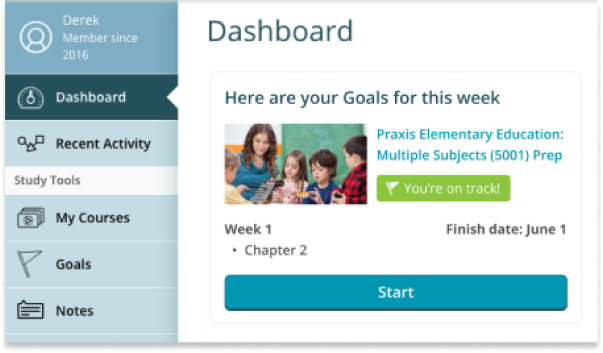
Get a personalized test prep course for the CBEST Math.
Take an assessment and focus on the areas that need the most practice.
CBEST registration for the Math exam is available online 24 hours a day, 7 days a week, through the California Educator Credentialing Assessment website. You will have to create an account if you don't already have one and select your test type, choose your testing location, and designate institutions to receive your results. If you choose to take the test at home or another private location, you must only select your desired date and time to take the test. There will also be some background questions and an agreement to the testing rules that must be completed as part of the registration process.
Testing Type
There are three methods of taking the CBEST Math exam: computer-based, paper-based, and online proctored. The computer-based test takes place at a testing facility of your choice, as does the paper test. The paper test, however, is being phased out, and any available test dates for this format may be cancelled. CBEST online proctoring test can be taken on a private desktop or laptop computer with a webcam and microphone. You must first take a system test to ensure that the computer and network connection (preferably wired) meet the minimum requirements. You will have to download the OnVUE application before you begin and capture photos of your environment to ensure the security of your test.
Registration Fees
The CBEST registration fee for the computer-based and online-proctored Math exam is $30, while the paper-based exam is $41. Your registration is valid for one year after your payment, with no refund or credit after that time. You will need a credit or debit card to make the payment online.
Testing Location and Dates
The available appointments are different for all of the three test methods. To take the test, you will need a government-issued form of ID, such as a driver's license, passport, or alien registration card (green card).
Computer-based test: When you register, you will be able to select an appointment at a nearby testing facility. This method has the most available appointments, available Monday through Saturday and including some holidays. The exam is 2 hours long, and you may take restroom breaks which will count toward your total time.
Paper-based test: There are a very scarce number of appointments available for the paper-based exam as this method is soon to be retired, and future dates are subject to cancellation. Paper-based test dates only occur once every 2 to 3 months. You are automatically registered for all 3 sections of the CBEST, not just the math section, but you can take the CBEST Math and be scored separately, as if taking it individually. There is no alternative to this arrangement for the paper-based test. You will, however, have 4 hours to complete it and must arrive by 7:30 am to the testing center.
Online-proctored test: The newer form of the CBEST Math test has week-long appointment windows available once a month. There are strict performance minimums for your network and computer, as well as limitations on your physical environment, including where you'll be sitting for the test. You are not permitted to take breaks of any kind while taking the online proctored CBEST Math test.
Test Requirements and Policies
Each CBEST test has slightly different policies; however, you are not permitted to use or carry a cell phone or any other electronic device, a calculator, handwritten materials, hats, any kind of food or drink, or any personal items such as a wallet or watch. For the online-proctored test, you may not eat, leave your seat, or have any other person in your testing environment; you must stay strictly within your webcam view during the entirety of the test. You also may not speak, mumble, or move your webcam. Any of these violations for the online proctored test may cause your test to be stopped. The paper-based CBEST Math test has the same limitations as the computer-based form, and for all tests it is essential that you are punctual, or you will not be permitted to sit the test.
Concise, engaging video lessons
Master concepts quickly with clips from expert instructors. You get both video lessons and test transcripts.
Save time by quickly reviewing video transcripts for essential lesson information.
The number of questions you answer correctly out of the 50 on the CBEST Math test is called your raw score. This raw score is then converted to a scaled score ranging from 20 to 80. The CBEST passing score for the Math test is a scaled score of at least 41. If you take all of the CBEST sections at once, you can technically pass the CBEST Math section with a lower score if your total across all sections is 123 or higher; however, in this scenario you must achieve a math section score of at least 37. Your scores will be forwarded to whichever organization you designate to receive them, and you will receive transcripts and a permanent verification card for you records.
TeacherCertification.com
Find self-paced CBEST Math prep courses.
Find a study plan that can get you ready for your certification exam, whether you have six months or six days.
The CTC website provides ample information and resources regarding how to pass the CBEST Math section. The most reliable way to pass the test is to use a CBEST Math study guide and a practice test. Be sure to begin by reviewing the test specifications, as stated by CBEST, including all the required skills for the CBEST Math exam. There are many study guides available as books, videos, or online courses. All of these can support your studying by breaking down the individual sections into discrete, learnable skills. A CBEST Math study guide will then teach each skill and, when paired with a CBEST Math practice test, give you the knowledge and confidence to take the final test.
CBEST Math Formulas
You will need to know multiple basic math formulas in order to be prepared to take the CBEST Math section. Again, the test does not determine if you're able to teach or explain these formulas, it simply tests your knowledge of and ability to apply them. Below are just some of the formulas you may need, involving estimation, computation, measurement, and statistics:
How to calculate a perimeter
How to average a set of numbers by dividing the sum by the set
How to calculate the percentage of a number from a whole
Calculate numerical probabilities of an occurrence from given information
Multiple operations with fractions
Solve simple equations for an unknown variable
Conversion from fractions to percentages or vice versa
CBEST Math Practice Tests
A CBEST practice test can help train you by familiarizing you with the kinds of questions you may encounter on the final test and the length of time you will have. The CTC has paper-based tests available for download featuring realistic sample questions you can use for your study as well as computer-based testing tutorials you can use to prepare for those tests. There are several online versions of the CBEST test prep if you prefer more of a computer-based approach, as well as numerous books featuring study guides and practice tests.
Expert Contributor
Lindsey Seril
Lindsey Seril, M.Ed. has worked as a teacher for 8 years. She passed the CSET and CBEST exams while obtaining her license. Lindsey also holds Montessori teacher certifications for early childhood and elementary school. She earned her M.Ed. from St. Catherine's University and her Bachelor's degree in Liberal Studies from Sonoma State University.
Frequently Asked Questions
How do I pass the math CBEST?
Preparation is key. You can try to achieve this by reviewing CBEST Math practice tests as well as study guides. Make sure you are also familiar with the specifications for the CBEST Math test. All of these can give you a clear idea of the kinds of questions you will encounter on the test, and what you should review as you study toward it.
Is the CBEST test hard?
The CBEST Math exam tests basic mathematics knowledge for future educators before they can gain licensure as a teacher. While you may not have taken any math classes recently and are wondering how to pass the CBEST Math test, using a CBEST Math study guide and taking a CBEST Math practice test may help you prepare and make you feel more confident about taking the test on the day.
Over 100,000 Video Lessons & Practice Questions - All In One Place.